ASTRONOMY
SPACE TELESCOPES
Telescopes like The Hubble Telescope and the James-Webb Telescope are placed directly in Space where they do not have to deal with a planet’s atmosphere.
Launched in 1990, the Hubble scope revolutionized astronomy by providing incredibly detailed images of the universe from Earth’s orbit -free from atmospheric distortion. It has captured iconic views of galaxies, nebulae, and distant stars, greatly expanding our understanding of cosmic evolution.
James Webb Telescope
The James Webb Space Telescope (JWST) is NASA’s most advanced space observatory, launched on December 25, 2021. Positioned about 1.5 million kilometers from Earth, it orbits the Sun at a stable point known as Lagrange Point 2 (L2). Webb is designed to observe the universe in infrared light, allowing it to see through cosmic dust and detect some of the earliest galaxies formed after the Big Bang. Its massive 6.5-meter gold-coated mirror makes it far more powerful than the Hubble Space Telescope. JWST is revolutionizing astronomy by capturing detailed images of distant planets, stars, and galaxies, and helping scientists study the atmospheres of exoplanets for signs of life. It is a collaborative project involving NASA, ESA (Europe), and CSA (Canada).
THE SEARCH FOR EXTRATERRESTRIAL LIFE
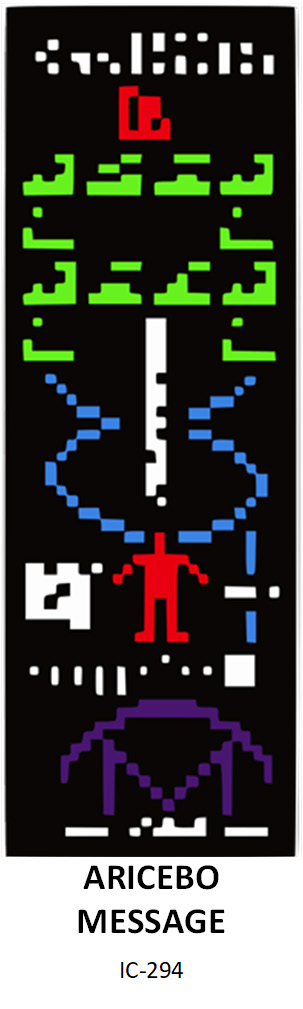
In 1974, humanity made its first deliberate attempt to contact alien life by sending a radio message into space. Transmitted from the Arecibo Observatory in Puerto Rico, the signal was aimed at Messier 13 (M13), a globular star cluster located about 25,000 light-years from Earth. The message was a A binary-coded message composed of 1,679 bits, arranged to form images representing numbers, DNA, a human figure, the solar system, and the Arecibo telescope itself.
Encounter Message: Scientists expressed concern that over its 25,000-year journey, the Arecibo message could be degraded by cosmic interference, potentially rendering it unreadable if even a few bits were lost. To address this issue, on the 25th anniversary of the Arecibo transmission in 2001, a new signal -called the Encounter 2001 message -was broadcast toward the Hercules constellation. This updated message was designed with error resilience in mind, meaning it could still be partially understood even if some of the data were lost or corrupted during transmission.
The Drake Equasion: Invented by Frank Drake in 1961, the Drake Equation is used to estimate not only how likely it is that life exists outside our planet, but also the odds of humans being able to find intelligent life in the Universe. The equation takes into account several factors that influence the likelihood of intelligent life existing elsewhere in the Universe, as well as the chances of humans being able to detect or communicate with such civilizations.