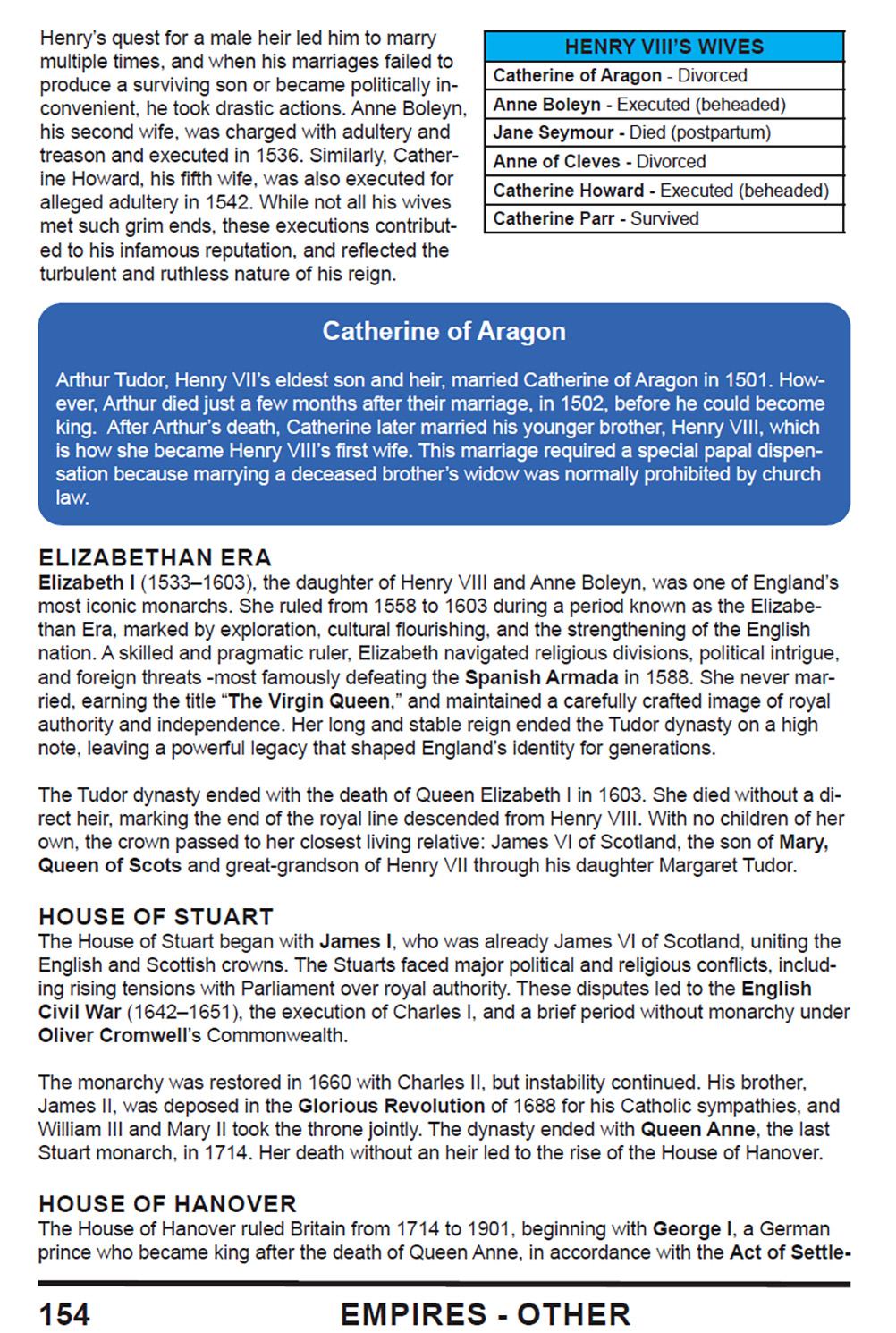
Henry’s quest for a male heir led him to marry multiple times, and when his marriages failed to produce a surviving son or became politically inconvenient, he took drastic actions. Anne Boleyn, his second wife, was charged with adultery and treason and executed in 1536. Similarly, Catherine Howard, his fifth wife, was also executed for alleged adultery in 1542. While not all his wives met such grim ends, these executions contributed to his infamous reputation, and reflected the turbulent and ruthless nature of his reign.
Catherine of Aragon
Arthur Tudor, Henry VII’s eldest son and heir, married Catherine of Aragon in 1501. However, Arthur died just a few months after their marriage, in 1502, before he could become king. After Arthur’s death, Catherine later married his younger brother, Henry VIII, which is how she became Henry VIII’s first wife. This marriage required a special papal dispensation because marrying a deceased brother’s widow was normally prohibited by church law.
Elizabeth I (1533–1603), the daughter of Henry VIII and Anne Boleyn, was one of England’s most iconic monarchs. She ruled from 1558 to 1603 during a period known as the Elizabethan Era, marked by exploration, cultural flourishing, and the strengthening of the English nation. A skilled and pragmatic ruler, Elizabeth navigated religious divisions, political intrigue, and foreign threats -most famously defeating the Spanish Armada in 1588. She never married, earning the title “The Virgin Queen,” and maintained a carefully crafted image of royal authority and independence. Her long and stable reign ended the Tudor dynasty on a high note, leaving a powerful legacy that shaped England’s identity for generations.
The Tudor dynasty ended with the death of Queen Elizabeth I in 1603. She died without a direct heir, marking the end of the royal line descended from Henry VIII. With no children of her own, the crown passed to her closest living relative: James VI of Scotland, the son of Mary, Queen of Scots and great-grandson of Henry VII through his daughter Margaret Tudor.
The House of Stuart began with James I, who was already James VI of Scotland, uniting the English and Scottish crowns. The Stuarts faced major political and religious conflicts, including rising tensions with Parliament over royal authority. These disputes led to the English Civil War (1642–1651), the execution of Charles I, and a brief period without monarchy under Oliver Cromwell’s Commonwealth.
The monarchy was restored in 1660 with Charles II, but instability continued. His brother, James II, was deposed in the Glorious Revolution of 1688 for his Catholic sympathies, and William III and Mary II took the throne jointly. The dynasty ended with Queen Anne, the last Stuart monarch, in 1714. Her death without an heir led to the rise of the House of Hanover.
The House of Hanover ruled Britain from 1714 to 1901, beginning with George I, a German
prince who became king after the death of Queen Anne, in accordance with the Act of Settle-